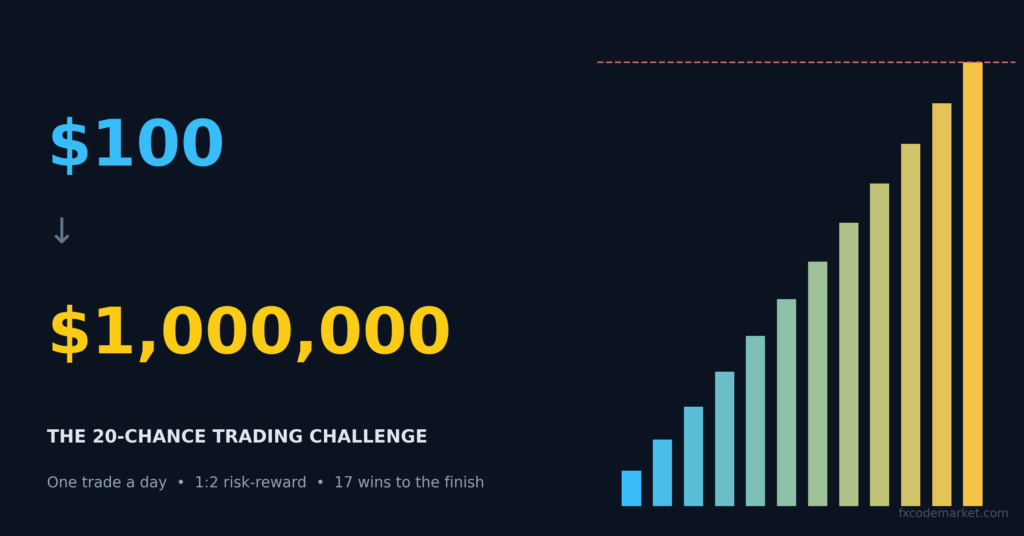
Most “compounding” strategies you see online are vague. This one isn’t. It’s a strict, rule-based challenge: start with $100, take exactly one trade per day, only take 1:2 risk-reward setups, and let the math do the rest.
Here’s how it works, why the numbers land where they do, and what it actually takes to pull it off.
The Rules
That last rule is the entire engine behind this strategy. Every win compounds directly into the next day’s risk.
Think of It as a 17-Step Ladder
Picture the strategy as a staircase with 17 steps. Step 1 risks $5 to make $10. Step 2 risks $10 to make $20. Every step up doubles both the risk and the reward, all the way to Step 17, which risks $327,680 to make $655,360 — the trade that pushes you past $1,000,000.
A win moves you up one step. A loss moves you down one step. That’s the whole system.
The only exception is Step 1, the ground floor. There’s no step below it, so a loss there doesn’t move you anywhere — it just spends one of the twenty $5 slices that make up your original $100, and your next trade is taken from Step 1 again. Lose all twenty of those $5 slices while sitting on Step 1, and the $100 is gone. That’s the real “20 chances” in this challenge — not 20 chances to hit $1,000,000, but 20 chances to land the win that gets you climbing.

Once you’re above Step 1, a loss costs real money, but it doesn’t erase your climb — it only knocks you down a rung.
Example: say five straight wins have taken your $100 to $410, and you’re standing on Step 6, about to risk $160 to make $320. You take the trade and lose. Your balance drops to $250, and tomorrow you’re back on Step 5, risking $80 instead of $160. You didn’t fall back to a $5 trade — you fell back one step, and you keep climbing from there.
Why It Only Takes 17 Wins to Hit $1,000,000
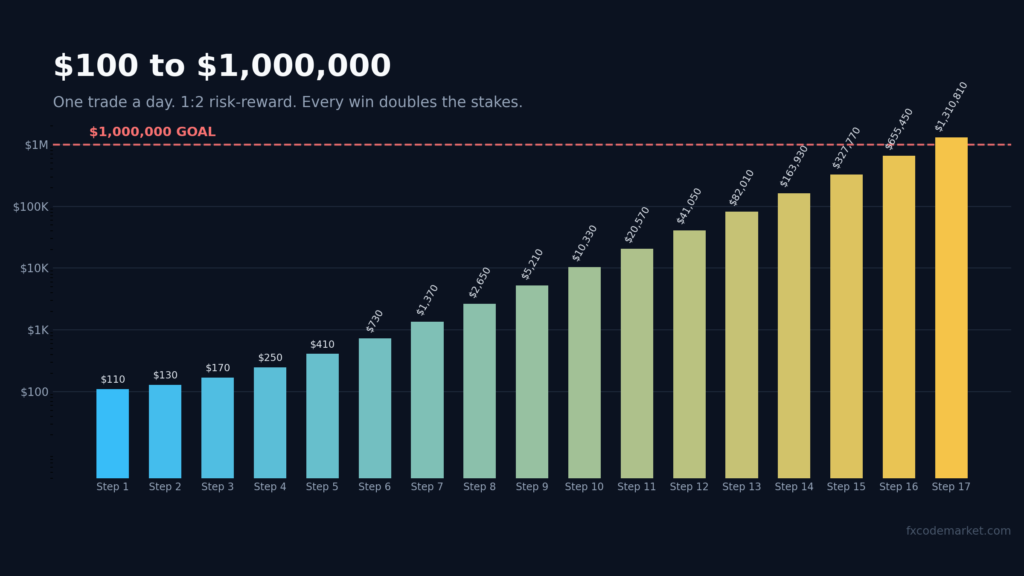
Here’s where it gets interesting. Once you start winning, you’re not risking $5 anymore — you’re risking whatever you just made, every single day. Because every trade is 1:2, your winnings roughly double the size of your next trade’s payout. That’s exponential growth, and exponential growth moves faster than most traders expect.
Run it out on a streak of consecutive wins:
| Step | Risk | Reward | Balance After |
|---|---|---|---|
| 1 | $5 | $10 | $110 |
| 2 | $10 | $20 | $130 |
| 3 | $20 | $40 | $170 |
| 4 | $40 | $80 | $250 |
| 5 | $80 | $160 | $410 |
| 6 | $160 | $320 | $730 |
| 7 | $320 | $640 | $1,370 |
| 8 | $640 | $1,280 | $2,650 |
| 9 | $1,280 | $2,560 | $5,210 |
| 10 | $2,560 | $5,120 | $10,330 |
| 11 | $5,120 | $10,240 | $20,570 |
| 12 | $10,240 | $20,480 | $41,050 |
| 13 | $20,480 | $40,960 | $82,010 |
| 14 | $40,960 | $81,920 | $163,930 |
| 15 | $81,920 | $163,840 | $327,770 |
| 16 | $163,840 | $327,680 | $655,450 |
| 17 | $327,680 | $655,360 | $1,310,810 |
Notice how flat the growth looks for the first week, and how violently it accelerates after day 12. That’s compounding — it’s slow until it isn’t. By day 17, a $100 account that’s only taken 1:2 trades has crossed seven figures.
This table shows the best case — an unbroken run up the ladder. In reality, a loss along the way sends you down one step (or costs $5 flat if you’re still on Step 1) rather than back to zero, so most runs will zig-zag up the steps rather than climb them in a straight line.
The Part Most People Skip: This Requires Discipline, Not Luck
Seventeen consecutive winning trades sounds simple written out in a table. It isn’t. A single loss anywhere in that streak knocks you back down one step, and you have to climb back to where you were before you can keep pushing toward $1,000,000. The strategy doesn’t fail because the math is wrong — it fails when traders get impatient, break rule #3, and take a setup that isn’t really a clean 1:2.
The entire challenge lives or dies on two things: patience to wait for genuine 1:2 setups, and precision on every single entry — because at $327,680 of risk on day 17, there’s no room for a sizing mistake.
That’s exactly the kind of precision the Smart Lot Calculator is built for. As your risk amount changes every single day in this strategy — $5, then $10, then $20, all the way up into six figures — you need your position size calculated correctly every time, with your risk:reward ratio locked in and verified before you click buy or sell. One miscalculated lot size on a large compounding day can undo several days of progress.
The Psychology Behind the Strategy
The rules are simple. Sticking to them for 17 days in a row, while the dollar amounts get bigger and the pressure gets heavier, is the actual challenge.
| TRAIT | WHAT IT MEANS |
|---|---|
| Patience | Wait for a real 1:2 setup. If it’s not there, don’t trade. |
| Discipline | Follow the same rules every day. No exceptions, no shortcuts. |
| Stay calm about money | Treat a $50,000 trade the same as a $50 trade. |
| Accept losses | Losses are part of the plan, not a sign you’re doing it wrong. |
| No revenge trading | Never add an extra trade to “win back” a loss. |
| Stay consistent | Trade Day 17 exactly like you traded Day 1. |
| Be realistic | Most attempts won’t reach $1,000,000 — that’s normal, not failure. |
| Focus on the process | Your only job each day is finding one good setup. Don’t watch the balance. |
Should You Actually Run This?
Treat this as what it is: an aggressive, high-variance challenge, not a retirement plan. Seventeen straight winners is a real ask — even excellent traders don’t win every trade, and a string of $5 losses eating into your 20 chances is a normal, expected part of running this. The strategy is honest about its own math: you’re not guaranteed to reach $1,000,000, and you’re risking the full $100 to try.
What makes it worth writing about is the discipline it forces. One trade a day. Only 1:2 setups. No revenge trading, no oversizing, no deviating from the plan because a losing streak got frustrating. If you can hold to those three rules, the compounding takes care of itself.